Tuesday, September 8, 2009

Monday, September 7, 2009
Hair/Fiber
Hairs, which are generated mostly of the protein keratin that, can be classified as slender outgrowths of the skin of mammals. Each species of animal possesses hair with distinctive length, color, shape, root form, and internal microscopic features that differentiate one animal from another. Significant variability also exists in the types of hairs that are established on the body of an animal. In humans, hairs found on the head, pubic region, arms, legs, and other body areas have uniqueness that can determine their origin. On animals, hair types include coarse outer hairs or guard hairs, the finer fur hairs, tactile hairs such as whiskers, and other hairs that originate from the tail and mane of an animal.
Because hairs can be transferred at some stage in physical contact, their attendance can link a suspect to a victim or a suspect/victim to a crime scene. The types of hair recovered and the condition and number of hairs found all impact on their value as evidence in a criminal investigation. Comparison of the microscopic characteristics of questioned hairs to known hair samples helps determine whether a transfer may have occurred.
These are 3 main category of hair analysis:
Because hairs can be transferred at some stage in physical contact, their attendance can link a suspect to a victim or a suspect/victim to a crime scene. The types of hair recovered and the condition and number of hairs found all impact on their value as evidence in a criminal investigation. Comparison of the microscopic characteristics of questioned hairs to known hair samples helps determine whether a transfer may have occurred.
These are 3 main category of hair analysis:
chemical assys used to judge the use of illegal drugs, the existence of weighty metals in the body, and to experiment for nutritional shortage
the core of the hair is normally used for the DNA analyses
microscopic difference if hair can be determined if the hair from another place if they are the same person or animal.
Hair is conceived of 3 coatings
medull
cortex
cuticle
Positioning a suspect at a sight of a crime is what it is all about. 1 of the traditions that this can be done is by finding fabric fibers similar to those from the victim’s clothing or the crime scene on the clothing or person of the suspect otherwise uncovering fiber evidence at the crime scene that can in some way be tracked back to the suspect.
Fibers are regarded as a type of trace evidence that can be transmitted from the clothing of a suspect to the clothing of a victim at some point in the commission of a crime. Textile fibers can also be transferred from rugs or blankets; between two individuals; between an individual and an object or between two objects
Blood Types
Blood types were discovered in 1900 and 1901 at the University of Vienna by Karl Landsteiner in the progression of attempting to figure out, why blood transfusions at times initiate death and at other times save a patient. In 1930, he finally earned the Nobel Prize for this discovery.

All humans and many other primates can be typed for the ABO blood group. There are four primary types: A, B, AB, and O. There are two antigens and two antibodies that are mostly responsible for the ABO types. The precise combination of these four components determines an individual's type in most cases. The table below shows the possible permutations of antigens and antibodies with the corresponding ABO type ("yes" indicates the presence of a component and "no" indicates its absence in the blood of an individual).

The RhD System, some people are A+ (A positive), meaning they have the Rh antigen, those who are A- (A negative) do not have the Rh antigen.
84% of the population is Rh positive
84% of the population is Rh positive
I think that now in today’s time scientifical improvements are being made, so now less people are dying, which I personally love the idea of
Friday, September 4, 2009
Crime Scene Invesrigation
Evidence
1. Blood Samples: A and B
2. Fiber
3. A Fake Gold Chain
4. Size 8 shoe print
5. Scented Cotton ball that smelled of shampoo, possibly organic shampoo
6. Expo Marker
7. Hair Samples of an potential asian, dyed hair, and possibly gelled or greased hair
Possible Suspects: Mike Kelly, Kooladria Jones, Sam Tilson, Jenny Cho, Ralph Johnson, and Kevin Popadines
Possible Scenario
Using the evidence found it is clear exactly what happened.
1. It was suppose to just be a fun evening, with Kevin Popadine's wife's sister, so on this particular day he whisked Jenny Cho away to get her mind of off her horriable husband, but trouble struck. Always envious of her sister Jenny threatened to tell Popadine’s wife a deeply disturbed lie, and that couldn’t happen to Popadine’s, a young teacher who so far has had the perfect life. So they fought, Jenny struggled to get away but she was no match for the 6’0ft Popadine’s. Unable to think of anything else, Cho sprayed her perfume for his eyes but barely missing and getting the wall where the sample was collected. An angry Popadine’s than struck Cho, causing her eye to bleed, than a desperate to survive Cho grabbed her hair brush and swung at Popadine's, hitting him right in the jaw and ran desperate to survive and get away from the angered Popadines. The other evidence that we have found have yet to have been explained, however it does seem logical for the fake gold chain to have caught onto the door as she ran out of the cabin, and as for the expo marker it is highly acceptable that Popadine’s being a teacher placed it on the kitchen table and later forgot about it.
1. Blood Samples: A and B
2. Fiber
3. A Fake Gold Chain
4. Size 8 shoe print
5. Scented Cotton ball that smelled of shampoo, possibly organic shampoo
6. Expo Marker
7. Hair Samples of an potential asian, dyed hair, and possibly gelled or greased hair
Possible Suspects: Mike Kelly, Kooladria Jones, Sam Tilson, Jenny Cho, Ralph Johnson, and Kevin Popadines
Possible Scenario
Using the evidence found it is clear exactly what happened.
1. It was suppose to just be a fun evening, with Kevin Popadine's wife's sister, so on this particular day he whisked Jenny Cho away to get her mind of off her horriable husband, but trouble struck. Always envious of her sister Jenny threatened to tell Popadine’s wife a deeply disturbed lie, and that couldn’t happen to Popadine’s, a young teacher who so far has had the perfect life. So they fought, Jenny struggled to get away but she was no match for the 6’0ft Popadine’s. Unable to think of anything else, Cho sprayed her perfume for his eyes but barely missing and getting the wall where the sample was collected. An angry Popadine’s than struck Cho, causing her eye to bleed, than a desperate to survive Cho grabbed her hair brush and swung at Popadine's, hitting him right in the jaw and ran desperate to survive and get away from the angered Popadines. The other evidence that we have found have yet to have been explained, however it does seem logical for the fake gold chain to have caught onto the door as she ran out of the cabin, and as for the expo marker it is highly acceptable that Popadine’s being a teacher placed it on the kitchen table and later forgot about it.
Thursday, September 3, 2009
FORENSIC PICTURES= SCHOOL/WEB
Some of the following pictures were Madison Williams, I thank her for letting me use them


Tuesday, August 25, 2009


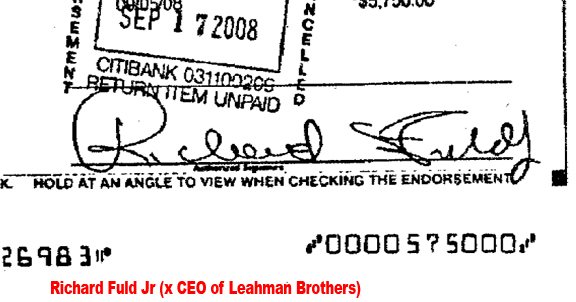
Lets Just say something about Handwriting The writing custom we learned during our time at school are very difficult to misplace, as we get use to the particular way that we clasp a pen, form the letters we write and how we space our words and lines. Those are the factors that prove informative during the analysis of a document. Investigators analyze these aspects of suspicious documents i.e the printing style, paper and ink, all of which help to identify a forged letter.
The handwriting section of forensic science involves relating and the authentication of written documents such as ransom notes, forged contracts, forged wills, fake ID's and passports and any additional form of writing or printed material. The analysis of someone's handwriting is most frequently used to prove that two documents were written by the same person. When looking at a person's handwriting, the examiners usually look for personalized characteristics under four areas including line quality, form, content and arrangement.
The analysis of writing involves investigating the shape of singular letters and identifying if the slant is in a certain direction, the size and how they are connected with the next letter. Strange characteristics, such as the use of a plus sign or the amperes and are also noted. Examining the content of written and printed papers is done to identify similarities between punctuation, spelling, grammar, vocabulary and paragraph phrasing.Document examiners contrast unidentified documents with a 'standard', a sample from a suspect. A standard is usually formed by the suspect under supervision. Even under supervision, the suspect still has the chance to disguise their handwriting, which is why investigators then have to collect other standards of casual handwriting from a suspect. The casual handwriting is undisguised and can therefore be compared with the unknown sample either with words that match or letter-by-letter.
Primarily, comparisons are done with the naked eye or with a hand held lens, however, the methods used today are by far more precise. Special lighting can help to reveal small, but valuable details about how a document was altered or created. Angled lights identify indents on the paper, which suggests that a signature was traced and also shows the roughness left on the paper after an eraser has been used. Backlighting makes areas where an eraser has been used, turn lighter and makes correction fluids dark. Examination using an infrared spectroscope can identify if ink, that appears the same colour, is actually from a different source by giving each color a different cipher.
In the beginning.... Before there was writing, there was only verbal communication, with cultural norms, rituals and stories passed on orally from one generation to the next. As language and cultures evolved, so did the need for communication. Simple drawings became pictographs, and pictographs became standardized within each culture.
What is writing? Writing is a codified system of standard symbols: the repetition of agreed-upon simple shapes to represent ideas. Recognizable systems of writing developed in 3 major cultures within 1200 years of each other. Sumerian cuneiform developed
around 3000 BC, Egyptian hieroglyphs around 2800 BC, and the precursor to Kanji Chinese around 1800 BC. The creation of writing permitted cultures to record events, history, laws; theories in math, science, medicine; generate literature and more.
Simple pictographs were used to represent people, places and things. As the needs for communication expanded, different pictographs were combined to represent ideas, and required knowledge to interpret the new symbols. These became ideographs: abstract symbols that evolved beyond the original drawings.
Monday, August 24, 2009
Types Of Fingerprints
Visible prints
Visible prints, also called patent prints are left in some netural, like blood, that expose them to the naked eye. They can be when blood, dirt, ink or grease on the finger come into contact with a smooth surface and leave a uneven ridge impression that is visible without development.
Latent prints
Latent prints are not apparent to the naked eye. They are formed from the sweat from sebaceous glands on the body or water, salt, amino acids and oils contained in sweat. The sweat and fluids create prints must be developed before they can be seen or photographed. They can be made sufficiently visible by dusting, fuming or chemical reagents.
Impressed prints
Impressed prints are also called plastic prints and are indentations left in soft pliable surfaces, such as clay, wax, paint or another surface that will take the impression. They are visible and can be viewed or photographed without development
Chemicals used to develop prints
There are four kinds of chemical reagents used to demostrate invisible, or latent, fingerprints. They are cyanoacrylate, silver nitrate, iodine, and ninhydrin.
The trade name for cyanoacrylate is super glue. Cyanoacrylate is the main ingredient that makes up 98% of Super Glue.
Silver nitrate is a chemical ingredient found in black-and-white photographic film. When silver nitrate is applied to a latent fingerprint, the chloride found in fingerprint residue interacts with the silver nitrate and forms another compound called silver chloride.
The third chemical used to reveal latent fingerprints is called iodine. When heated up, crystalline iodine releases iodine fumes into a fuming chamber, where the iodine interacts
Basic shapes/patterns of fingerprints
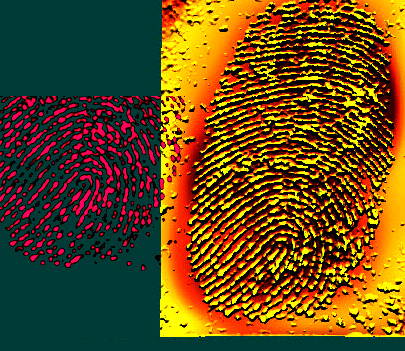
Finger prints are easily classified as there are four different basic shapes of pattern — arches, loops, whorls and composites — which are then subdivided according to things like the numbers of ridges between certain points in the pattern.
Visible prints, also called patent prints are left in some netural, like blood, that expose them to the naked eye. They can be when blood, dirt, ink or grease on the finger come into contact with a smooth surface and leave a uneven ridge impression that is visible without development.
Latent prints
Latent prints are not apparent to the naked eye. They are formed from the sweat from sebaceous glands on the body or water, salt, amino acids and oils contained in sweat. The sweat and fluids create prints must be developed before they can be seen or photographed. They can be made sufficiently visible by dusting, fuming or chemical reagents.
Impressed prints
Impressed prints are also called plastic prints and are indentations left in soft pliable surfaces, such as clay, wax, paint or another surface that will take the impression. They are visible and can be viewed or photographed without development
Chemicals used to develop prints
There are four kinds of chemical reagents used to demostrate invisible, or latent, fingerprints. They are cyanoacrylate, silver nitrate, iodine, and ninhydrin.
The trade name for cyanoacrylate is super glue. Cyanoacrylate is the main ingredient that makes up 98% of Super Glue.
Silver nitrate is a chemical ingredient found in black-and-white photographic film. When silver nitrate is applied to a latent fingerprint, the chloride found in fingerprint residue interacts with the silver nitrate and forms another compound called silver chloride.
The third chemical used to reveal latent fingerprints is called iodine. When heated up, crystalline iodine releases iodine fumes into a fuming chamber, where the iodine interacts
Basic shapes/patterns of fingerprints
Finger prints are easily classified as there are four different basic shapes of pattern — arches, loops, whorls and composites — which are then subdivided according to things like the numbers of ridges between certain points in the pattern.
Subscribe to:
Posts (Atom)



_54.jpg)